Genicular Artery Embolisation
What to expect from GAE, start to finish
From the first consultation through to the weeks after, here is what genicular artery embolisation actually involves. It is a minimally invasive, image-guided day procedure for knee osteoarthritis pain, with no surgical incision and no joint replacement.


Dr Mihir Desai & Dr Suhrid Lodh
Vascular & Interventional Radiologists · FRANZCR EBIR
Genicular artery embolisation is performed at St George and Macquarie University Hospitals. More about the team →

What happens at your consultation
- 1We review your historyWe talk through your symptoms, how long they've lasted, and what treatments (physiotherapy, injections, medication) you've already tried.
- 2We review your imagingWe assess your X-rays or MRI to understand whether your pain pattern is predominantly inflammatory, or whether structural damage is now the main driver.
- 3We explain your optionsWe explain whether GAE is likely to help in your case, and if surgery would serve you better, we say so and can refer you to a surgeon.
Who GAE is best suited to
GAE is used for knee osteoarthritis pain that no longer responds to physiotherapy or injections, in patients who want to delay or avoid a knee replacement. It targets inflammation rather than the mechanical structure of the joint, so patients with severe structural damage are usually better suited to joint replacement.
Bring your referral and any recent imaging to your appointment. A GP or specialist referral is required; GPs can refer via HealthLink (EDI: mihdesai), by email, or by phone on (02) 9812 3838.
What happens on the day
Pinhole access
A small puncture is made at the groin under local anaesthetic and light sedation. There is no surgical incision, and no general anaesthetic for most patients.
Micro-catheter to the knee
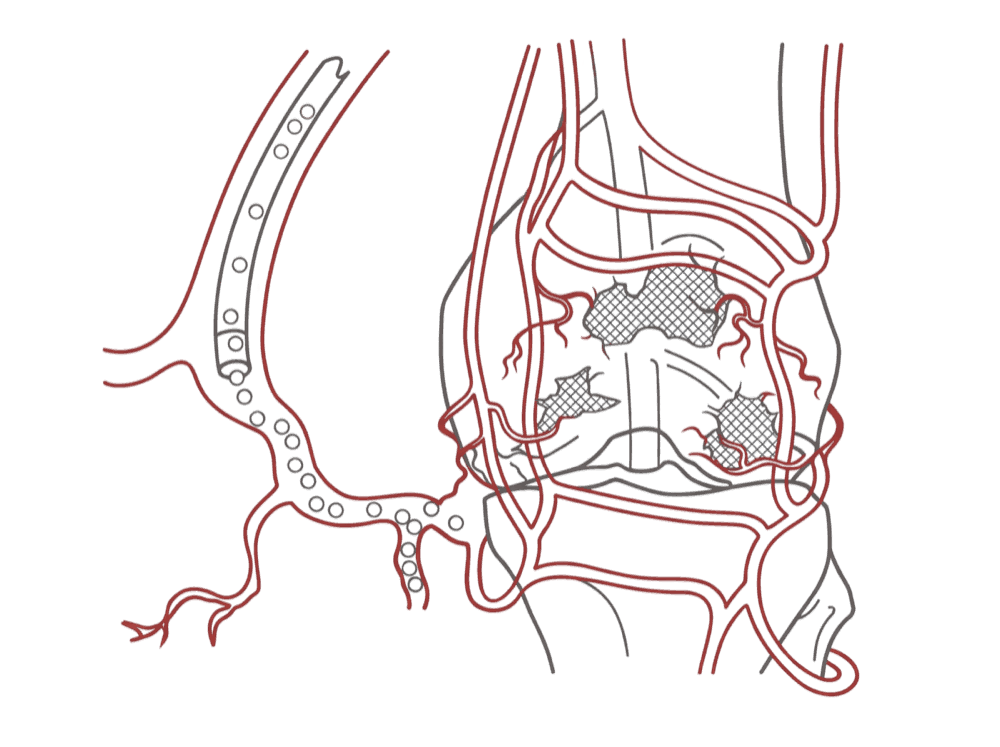
Using advanced imaging, a micro-catheter about 0.5 mm across is guided to the arteries supplying the inflamed knee tissue.
Block the abnormal vessels
The abnormal vessels, as small as 100 microns, are blocked with microscopic particles, while the normal blood supply to the knee remains intact.
Home the same day
You rest for a few hours and head home the same afternoon, with a small dressing at the access point. Pain reduction typically begins within one to two weeks.
How long it takes, and going home
The procedure itself takes one to two hours. Because it's performed through the arterial system rather than by opening the joint, there's no rehabilitation period, and most patients return to light activity within days.
Pain reduction typically begins within one to two weeks, with the full effect developing over six to twelve weeks as the treated vessels settle. For what to expect afterwards, see recovery & aftercare.

Your recovery timeline
- 1The same dayYou rest for a few hours after the procedure, then head home the same afternoon with a small dressing at the access point.
- 2The first daysThe knee commonly becomes more swollen for the first couple of days, and that settles by the end of the first week. There's no rehabilitation period, and most patients return to light activity within a few days.
- 31–2 weeksPain reduction typically begins within one to two weeks as the treated vessels settle and inflammation eases.
- 46–12 weeksThe full effect usually develops over six to twelve weeks. This is also when physiotherapy becomes more productive, as pain is no longer holding you back.
Common side effects
Temporary skin discolouration near the knee is the most common side effect, resolving without treatment within one to three weeks. Bruising at the access site is minor and self-limiting.
No severe complications were reported across 444 procedures in the largest published cohort (Fleckenstein et al., Radiology, 2025). Every patient and every procedure is different, so any specific concerns should be discussed with Dr Desai.
Considering GAE?
Dr Desai reviews your imaging and symptoms at your consultation and advises whether your knee pain is likely to respond to GAE.
Explore more
Written and reviewed by Dr Mihir Desai · Last reviewed August 2026