Enlarged Prostate (BPH) · Vascular & Interventional Radiology
Prostate Artery Embolisation (PAE)
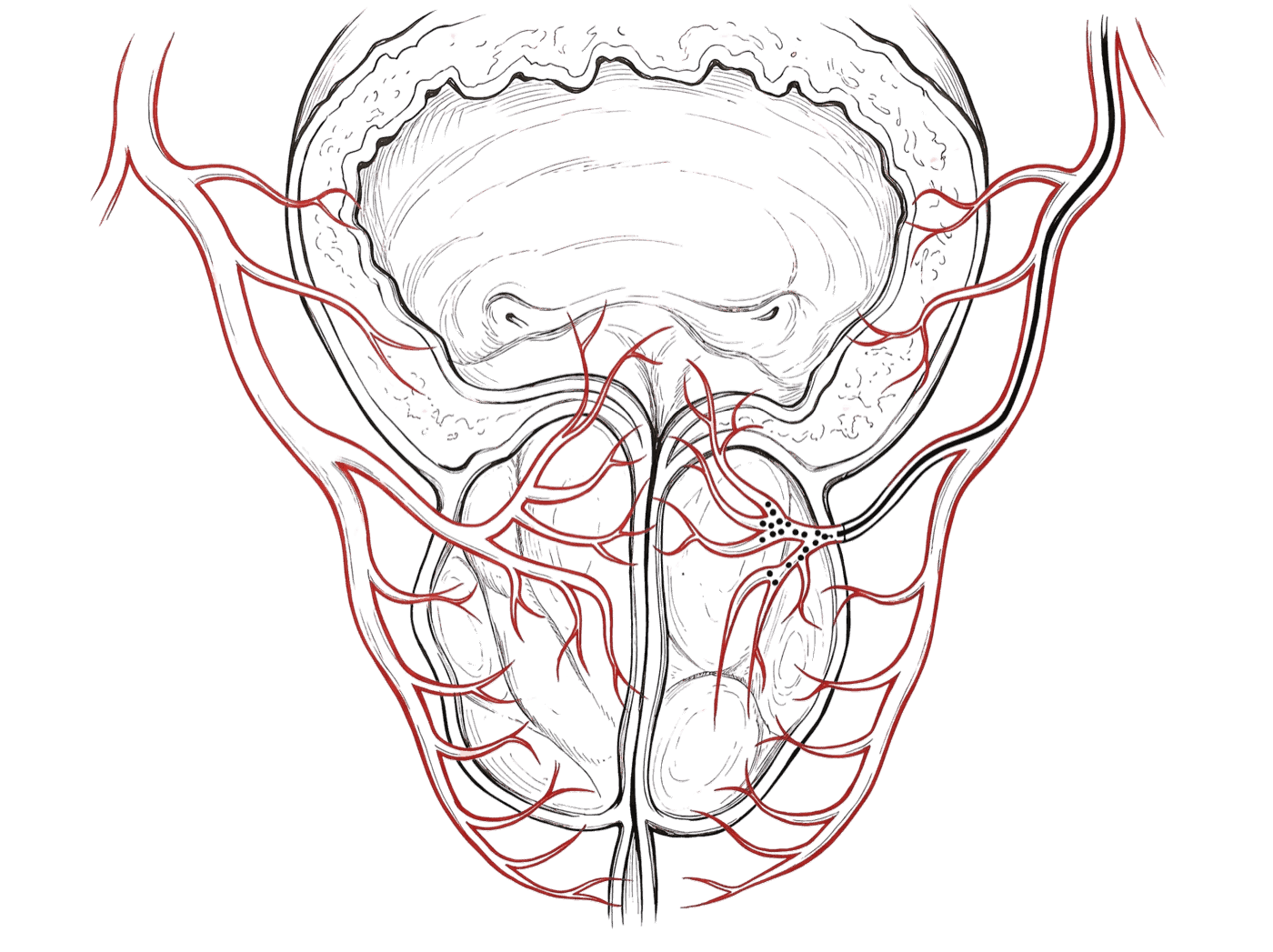
Prostate artery embolisation treats an enlarged prostate (BPH) by reducing the blood supply to the gland, causing it to shrink over several weeks and easing pressure on the urethra. It is a minimally invasive, image-guided procedure, accessed through a small puncture at the wrist or groin, with no instruments passing through the urethra, and it is often done as a day procedure.


Dr Suhrid Lodh & Dr Mihir Desai
Vascular & Interventional Radiologists · FRANZCR EBIR
Prostate artery embolisation is performed at St George and Macquarie University Hospitals, by two interventional radiologists who focus on the procedure. More about the team →









The daily toll of an enlarged prostate
An enlarged prostate rarely stays a private inconvenience. Waking several times a night to pass urine wears down your sleep, and with it your energy and mood. Days start to bend around where the nearest bathroom is, and long trips, meetings or a good night out begin to feel like a gamble.
These symptoms are common, and they are treatable. When tablets no longer control them, or their side effects become their own problem, PAE is one of the options worth discussing.
What is BPH, and how does it cause urinary symptoms?
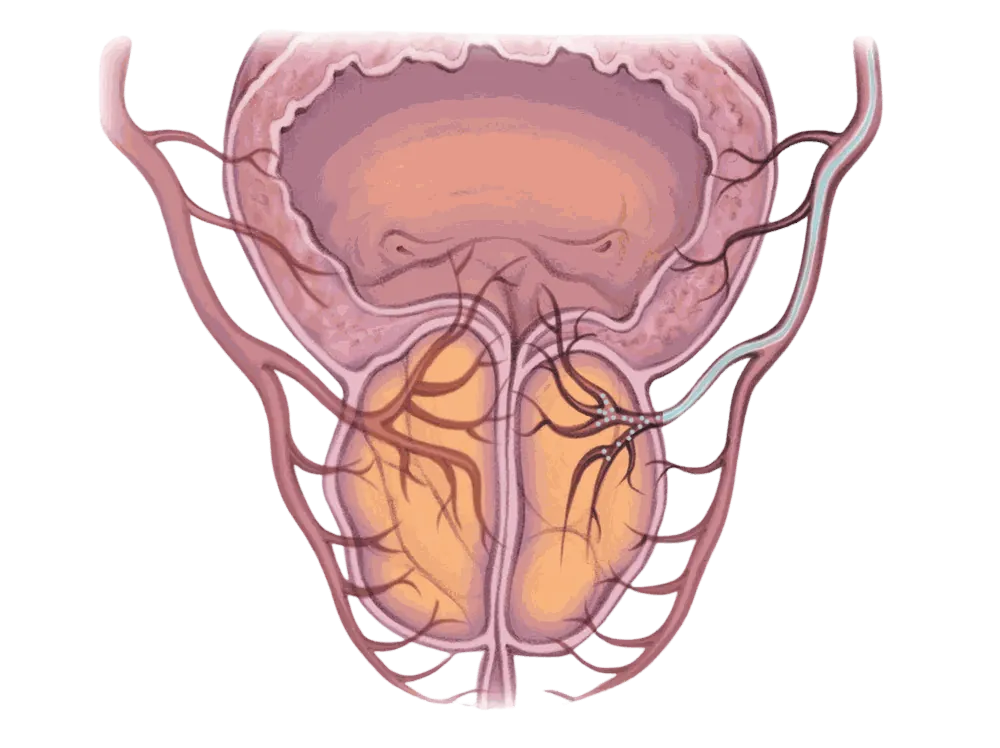
The prostate surrounds the urethra. As it enlarges, in a process called benign prostatic hyperplasia (BPH), it constricts urinary flow. Common symptoms include needing to urinate frequently during the day or night, a weak or stop-start stream, a feeling that the bladder doesn't empty fully, and urgency that's difficult to delay.
BPH is not prostate cancer and does not increase cancer risk. When medication stops working or causes side effects, PAE is an option worth discussing with your doctor.
How does PAE work?
An image-guided day procedure, performed through a small puncture at the wrist or groin under local anaesthetic and light sedation.
Pinhole access
A small puncture at the wrist or groin under local anaesthetic and light sedation, with no instruments passing through the urethra.
Micro-catheter to the prostate
Using image guidance, a micro-catheter is advanced to the small arteries supplying the enlarged prostatic tissue.
Reduce the blood supply
Microscopic particles reduce blood flow to the prostate. It does not remove tissue; it reduces the supply that sustains the enlargement.
The gland shrinks
Over several weeks the gland shrinks, pressure on the urethra lifts and urinary flow improves. You go home the same day with a small dressing.
Does PAE work? What the trials show
PAE has a substantial evidence base and is recognised in international urology guidelines.
At one year, PAE and HoLEP produce comparable improvements in urinary symptoms, quality of life and flow rate, with PAE associated with fewer serious adverse events than HoLEP (Bhatia et al., BJUI Compass, 2024). In the PARTEM and P-ESY ADVANCE trials, PAE outperformed combined drug therapy in both urinary symptoms and sexual-function scores (Sapoval et al., Lancet Regional Health Europe, 2023; Brown et al., BJUI, 2024).
TURP and HoLEP produce greater improvements in urinary flow rate than PAE, because they remove tissue rather than reduce blood supply. If maximum flow improvement is your priority, we can refer you to a urologist to discuss surgical options.

Your journey with us
From first contact to recovery
A clear, unhurried pathway, from getting in touch to seeing your symptoms improve.
- 1Get in touchA GP or specialist referral is required. Ask your GP to refer via HealthLink (EDI: mihdesai), or contact our rooms.
- 2Your consultationWe review your imaging and symptoms, with a full urological assessment as standard, and explain whether PAE is likely to help.
- 3The procedureIf PAE suits you, it's scheduled as a minimally invasive day procedure, through a small puncture at the wrist or groin.
- 4RecoveryYou go home the same day. Most men notice improvement within two to four weeks, with the full effect over three to six months.
Cost & Medicare: PAE is covered by Medicare, and we see patients privately or in the public hospital system. More on cost →
GP or specialist? Refer a patient →
PAE, TURP and HoLEP: which is right for me?
They suit different patients at different stages of disease. The right choice depends on your symptoms, prostate size and priorities.
Prostate Artery Embolisation
Accessed through the arterial system under light sedation, as a day procedure. No instruments pass through the urethra. It reduces the blood supply, causing gradual shrinkage.
Ejaculatory function is preserved in the vast majority of patients (Mouli et al., Journal of Urology, 2024). The 2026 AUA guideline identifies PAE as appropriate for men on anticoagulant or antiplatelet therapy, given the lower bleeding risk.
TURP & HoLEP
Pass instruments through the urethra under general or spinal anaesthesia, removing or destroying prostatic tissue, which produces greater improvements in urinary flow rate than PAE.
Retrograde ejaculation occurs in 65–90% of men after TURP, and in the majority after HoLEP.
PAE carries a higher retreatment rate than TURP and HoLEP over time. Approximately 20% of men require retreatment within five years, and repeat PAE is safe and effective where it's needed.
We review your imaging, symptoms and priorities at your consultation, and can refer you to a urologist to discuss surgical options.
Who is a good candidate for PAE?
PAE suits men with moderate-to-severe BPH symptoms that no longer respond adequately to medication, with a prostate volume of 50 cc or larger. Results are less predictable in smaller glands.
PAE may be particularly suitable for men who wish to preserve ejaculatory function, who want to avoid general or spinal anaesthesia, and who are on anticoagulant therapy, for whom surgical bleeding risk is a concern.
PAE treats BPH specifically. Symptoms from urethral stricture or bladder dysfunction need a different assessment, and severe atherosclerosis may make arterial access difficult. A full urological assessment before PAE is standard practice and recommended by the AUA, which states PAE should be performed by interventional radiologists specifically trained in the procedure.
Is PAE safe?
PAE is performed as a day procedure, with no urinary catheter required and a zero transfusion rate in published series (Mouli et al., Journal of Urology, 2024).
In the first one to two weeks, you may notice pelvic discomfort, a mild fever and temporary changes in urinary frequency. This is an expected response to the embolisation and resolves without treatment. Major complications occur in approximately 2.5% of patients and resolve without lasting effects. No published series has reported urinary incontinence after PAE, and erectile function is not affected. Serious non-target embolisation is rare, with bladder and penile complications each reported in less than 1% of procedures.
Every patient and every procedure is different, and the balance of benefits and risks is discussed with you at your consultation.
Frequently asked questions
Common questions about PAE. If you're still unsure whether it's right for you, ask us directly.
Will PAE affect my sexual function?
Will PAE affect my bladder control?
How does PAE compare to TURP?
When will I notice improvement?
Is PAE covered by Medicare?
Do I need a referral?
What if symptoms return?
Can I have PAE if I'm on blood thinners?
Written and reviewed by Dr Mihir Desai & Dr Suhrid Lodh · Last reviewed August 2026