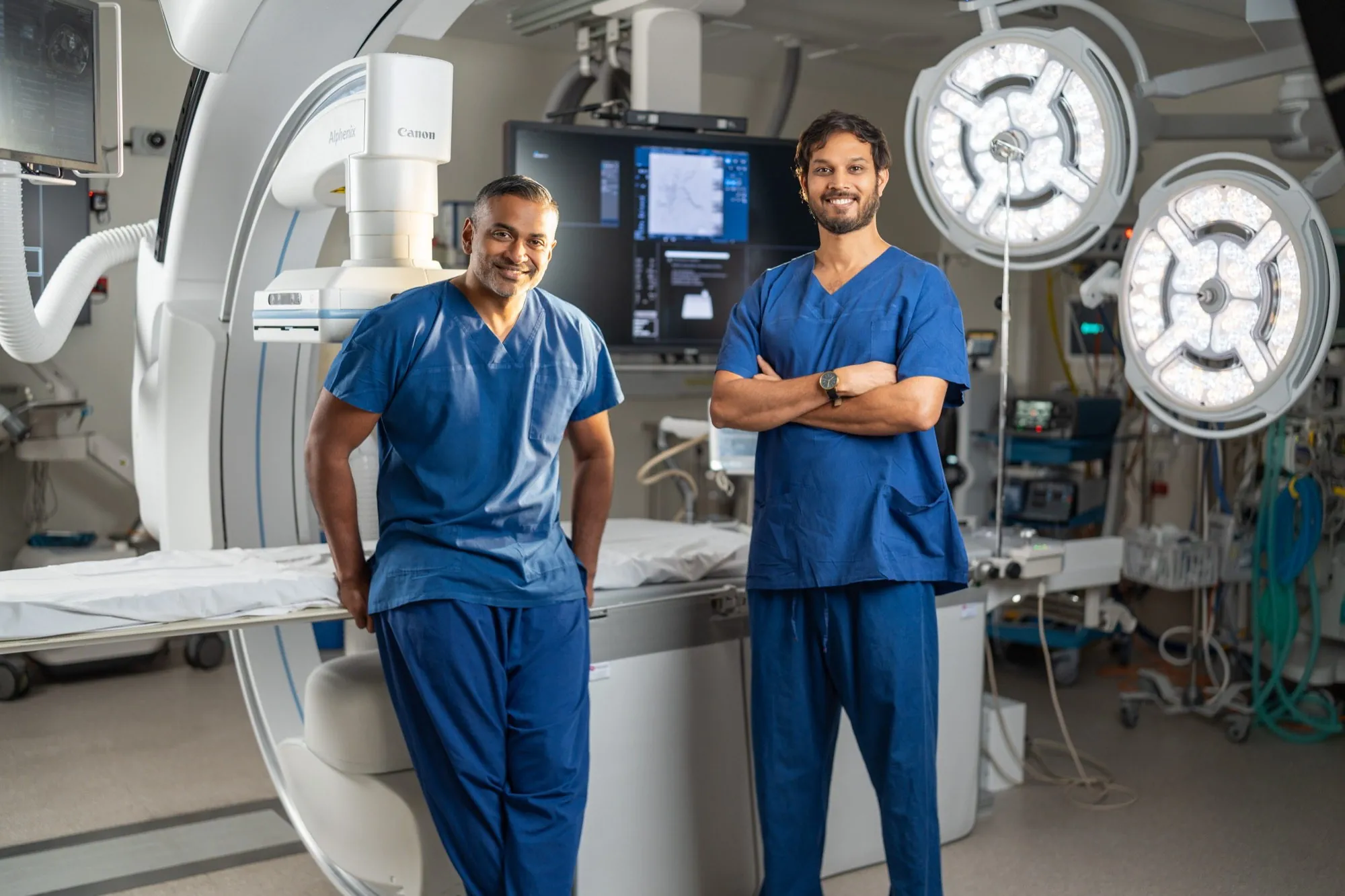
Dr Suhrid Lodh & Dr Mihir Desai St George & Macquarie University Hospitals · Meet the team →
Interventional radiology in Sydney, without open surgery.
Interventional radiology treats conditions from inside the body’s blood vessels. Using advanced imaging, we steer a micro-catheter through a pinhole in the wrist or groin to the place that needs treating. There is no surgical incision, and most patients go home the same day.
(02) 9812 3838
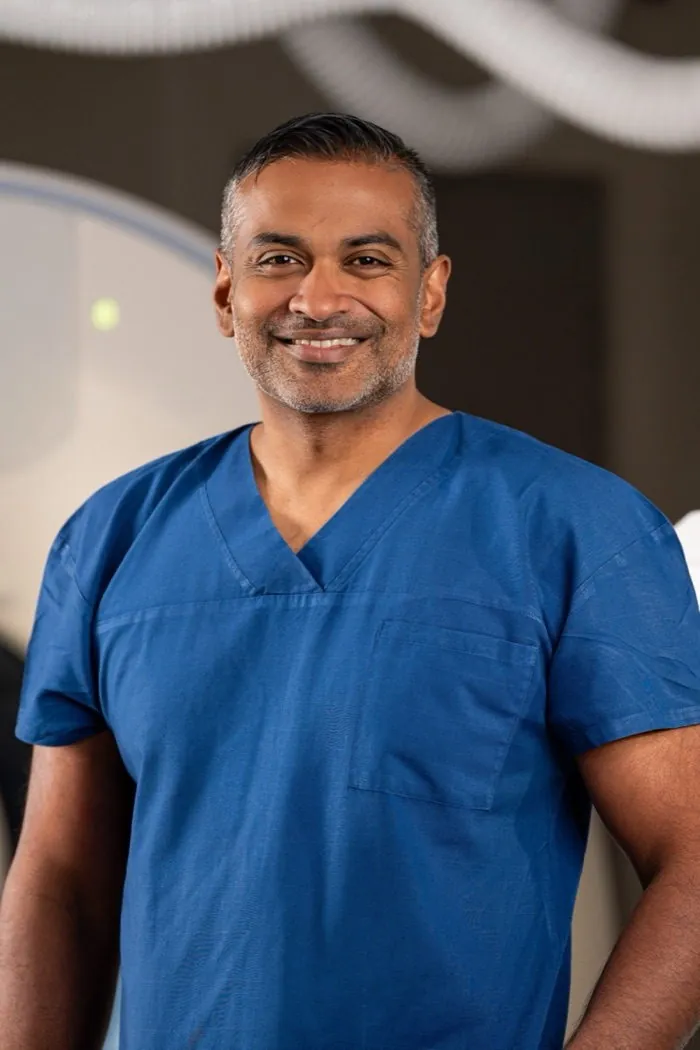
Dr Mihir Desai & Dr Suhrid Lodh
Vascular & Interventional Radiologists · FRANZCR EBIR
Dr Desai and Dr Lodh are vascular and interventional radiologists practising at St George and Macquarie University Hospitals. More about the team →






What interventional radiology is
Treating through the blood vessels, and the training that takes.
The blood vessels reach almost every organ in the body, and that is what makes this possible. An instrument small enough to travel along them can reach a target anywhere they go, without anything being cut open to get there.
Advanced imaging shows blood vessels and structures that are too small to see, and too small to operate on directly.
A micro-catheter is about half a millimetre across, fine enough to reach the small branches of an artery and treat one target while leaving the normal blood supply around it intact.
Because access is through a puncture a few millimetres wide, most procedures avoid a surgical wound, a general anaesthetic and an overnight stay. Patients are usually awake, under local anaesthetic and light sedation.
Dr Desai and Dr Lodh are both Fellows of the Royal Australian and New Zealand College of Radiologists (RANZCR). Beyond that fellowship, both completed dedicated sub-specialty training in advanced interventional work, a pathway that takes several further years.
What we treat
Much of our planned work is embolisation, which reduces the blood supply to tissue that is enlarged, inflamed or bleeding.
Enlarged prostate
Prostate Artery Embolisation (PAE)
PAE reduces the blood supply to an enlarged prostate so the gland shrinks over several weeks, easing pressure on the urethra. No instruments pass through the urethra.
Prostate artery embolisation (PAE) →Knee osteoarthritis
Genicular Artery Embolisation (GAE)
GAE targets the abnormal vessels driving inflammation in the knee joint lining, for patients whose pain no longer responds to physiotherapy or injections.
Knee osteoarthritis treatment (GAE) →Joint & tendon pain
Musculoskeletal Embolisation
Microembolisation targets the abnormal vessels that grow into damaged, inflamed tissue and bring pain-sensing nerves with them.
Musculoskeletal embolisation →How it differs from open surgery
Surgery reaches the target through the tissue above it. This reaches it from inside the artery.
Access is a pinhole
Treatment begins with a small puncture at the wrist or groin, not a surgical incision. Nothing is cut or removed, and there are usually no stitches.
Advanced imaging guides the treatment
Advanced imaging lets us work deep inside the body without disturbing the tissue above it, and at a smaller scale than an operation can reach.
Recovery is usually shorter
Without a surgical wound or a general anaesthetic, most patients go home the same day and return to light activity within a few days. Recovery varies by procedure and by patient.
The rest of our work
The treatments above are the ones people usually come to us for directly. Both doctors also do complex hospital work caring for acutely unwell patients.
It is an area both have a particular interest in, and they are closely involved in the emergency interventional service at St George Hospital. That includes the Code Crimson Trauma Team, called for patients with life-threatening bleeding, and the St George Pulmonary Embolism Response Team (PERT), for patients with blood clots in the lungs.
Both have extensive training and experience in interventional oncology, and led the IASIOS accreditation of the unit at St George Hospital, the first public hospital in Australia to achieve it. IASIOS is the international standard for interventional oncology services. They provide complex oncology interventions and sit on several oncology multidisciplinary teams.
Both doctors also treat conditions such as uterine fibroids, adenomyosis, nerve pain and aneurysms. If you would like to find out more, contact us and we will tell you whether we can help.
Where we treat
Consultations and procedures take place at two Sydney hospitals. Between them the two sites cover the lower North Shore, the inner west, and the St George and Sutherland areas.
Macquarie University Hospital
Level 3, Suite 304, 2 Technology Place,
Macquarie University NSW 2109
How to see us
Most patients arrive with a referral, but you do not have to wait for one to ask a question.
With a referral. A referral from your GP or specialist lets us review your history and any previous imaging before you arrive, and it is what allows a Medicare rebate to apply to the consultation. GPs and specialists can send a referral here.
Without a referral. You are welcome to contact us to ask whether one of these treatments might suit your situation. We will tell you what we would need to assess it properly, and we will say so plainly if we do not think it is the right option for you.
We reply to enquiries within one business day.
Frequently asked questions
Common questions about interventional radiology and how our practice works.
What is an interventional radiologist?
How is this different from surgery?
Do I need a referral?
Is interventional radiology covered by Medicare?
Will I be asleep during the procedure?
How do I know if I am suitable?
Written and reviewed by Dr Mihir Desai & Dr Suhrid Lodh · Last reviewed August 2026